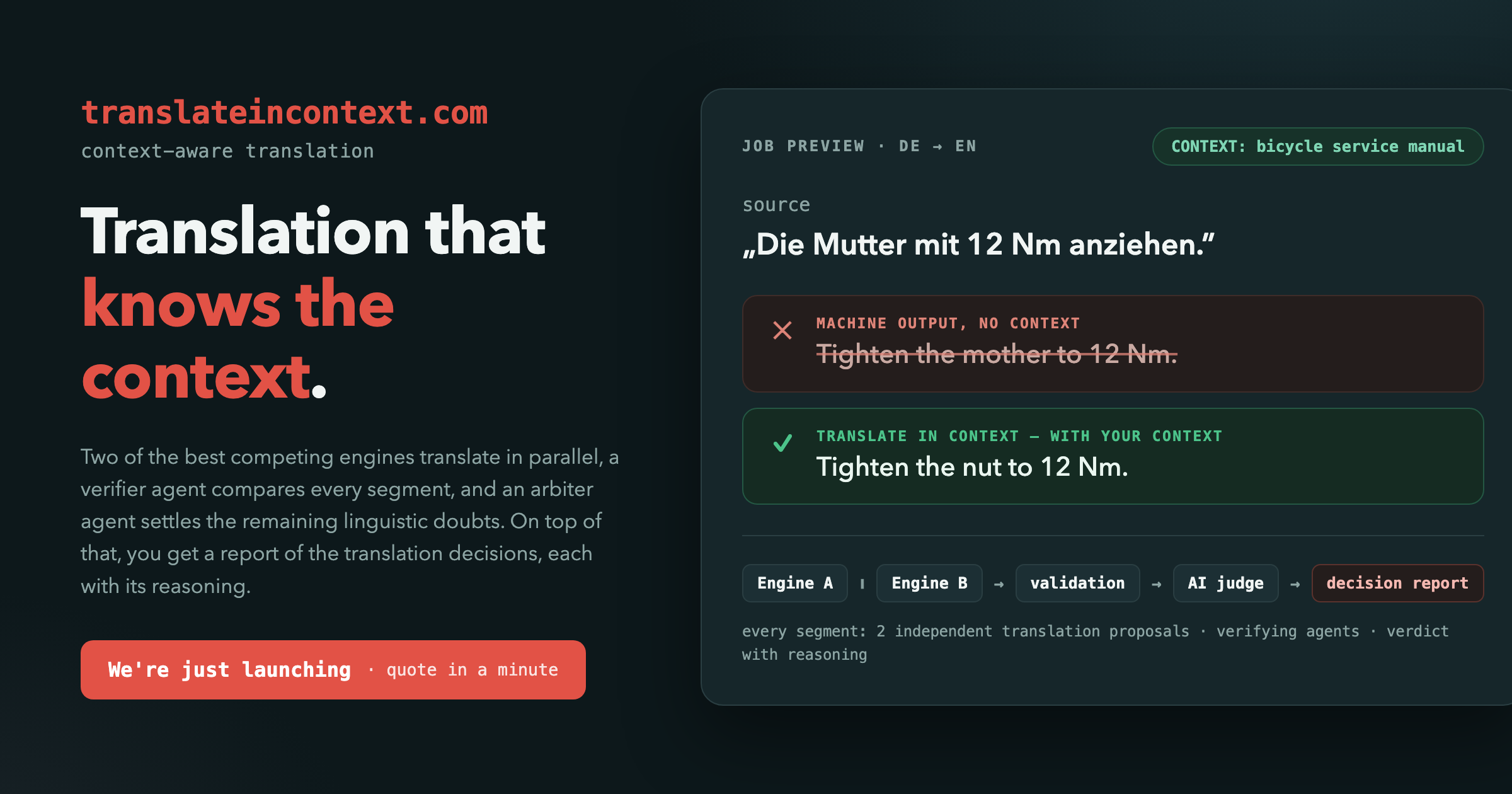
The missing link in the translation industry: contextual translation

Nothing is more annoying and disappointing than a lost opportunity. And for years, the translation industry has been remarkably good at generating them.
We had great UI translation tools, until software development methodology changed and left them with no UI left to visualise. CAT tools standardised their exchange formats, but left enough gaps in the specifications that true interoperability never quite arrived. Machine translation entered the market and created the post-editor role, which also handed everyone a convenient excuse to ignore input quality and expect the translator, now rebranded as a post-editor, to work with substandard output and like it. Then the LLM revolution came, and TMS and CAT vendors pretended nothing had changed: they bolted prompt wrappers and chatbots onto the same legacy process, ignoring the fact that sticking to segmentation guts most of the benefit modern AI could offer.
Where the industry keeps going wrong
A bit harsh? Perhaps. But all of this has gradually turned the industry into a place where everyone quietly follows processes we all secretly know are wrong. We probably can't change that at the industry level. What we can do is rethink the modern translation process from scratch, and apply it wherever possible.
The biggest mistake was focusing on corporate process and ignoring the core of the whole business: human translators. And what do translators actually want? Besides money, justice, coffee, and some recognition, they want context, because context directly shapes the quality of their work.
What translators actually want: a manifesto
- The human translator has the final say on linguistic choices: style, terminology, tone, wording. Always.
- Every input a translator sees should already carry the available context of the project, and the right terminology with it.
- No hassle. No installing tools, building filters, setting up projects, buying a license here and there, assembling packages and orchestrations. Translate a document, attach context, download the result and a report for review. That's it.
- No monthly or annual commitment to software, especially when you can't predict the flow of incoming jobs. Pay for the tech only when you use it. It's cheaper this way, and it's also fairer.
- A reference PDF attached "for information" was fine 20 years ago. Today, context needs to be actively used in the automated part of the translation, not just sit next to it.
- Context is multimodal. Sometimes it's a paragraph of description, sometimes a screenshot or a PDF. Translation shouldn't start without it, unless generic and dull is the goal.
- Even the best AI makes mistakes, so there's no reason to lock yourself into one provider. The real strength of an agentic, multi-layer AI stack is that it can work like a team of translators and reviewers, debating the best choices and improving the translation step by step. Just picking one MT engine and calling it a day is, at this point, a wasted opportunity.
Built on exactly these principles
If only something like this existed, built specifically on these principles... oh wait, it does. We've been working on it for a while, and we're proud to present two instances of it:
- translateincontext.com — the EN-first site.
- xl8.pl — its Polish spin-off, with an additional Bielik AI layer thrown in (to polish the Polish).
Contextual greetings!