
Portfolio · Product

Translate in Context / XL8

Document translation that uses the client’s context. Two independent engines translate in parallel, and verification points to the places that need a decision.

Live service: translateincontext.com for the international market, xl8.pl for Poland.

Our own Localize.pl project, not client work.

The problem and who it is for

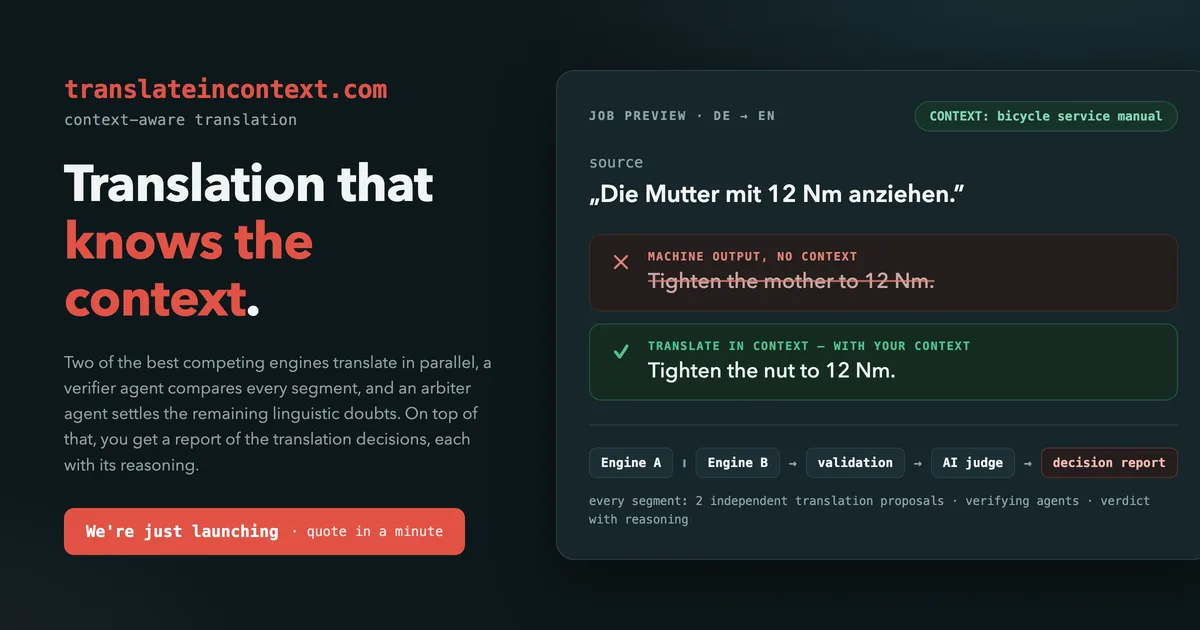
Machine translation knows the sentence but not the situation. In a bicycle service manual, “Tighten the nut to 12 Nm” is about a fastener, and no engine will guess that unless someone tells it what the document is.

Translate in Context is built for companies and translators who need document translation with terminology control and with insight into why the translation reads the way it does.

How it works

  1. Document and reference material
  2. Context analysis and a draft to approve
  3. Two engines translate in parallel
  4. Verification and resolution of discrepancies
  5. Document, XLIFF/TMX export and decision report
How it works: a simplified diagram, not a screenshot.
Translate in Context home page: the English sentence “Tighten the nut to 12 Nm.” translated without context (wrong) and with the context of a bicycle service manual (correct).
Screenshot of the translateincontext.com home page with a sample sentence.

What we built

Context approved before translation

The application first analyses the document and reference material, then shows an editable context draft. The user corrects the assumptions before translation starts, so a misreading of the document does not repeat in every segment.

Two independent proposals per segment

Every segment is translated in parallel by two engines from different vendors. A verifying agent compares the proposals and discrepancies go to resolution. Review focuses on the places where a decision is actually needed.

Glossaries checked by rules

Terms from TBX and CSV glossaries are also enforced by a plain, deterministic comparison. Terminology consistency does not depend on whether the next model response happens to remember them.

Translation decision report

The translation comes with a report that explains the decisions and lists the fragments that could not be resolved automatically.

Two markets, one product

The Polish version, xl8.pl, adds a step with the Polish Bielik model to polish the Polish text. Both versions share one application.

Technologies and their role

TechnologyRole
Next.js, React, TypeScriptOrder flow, context work and result review
PostgreSQL, PrismaJobs and translation process state
Vercel, Vercel BlobApplication hosting and document storage
Language models from two vendors, BielikTranslation, verification and resolution; Bielik in the Polish version
TBX, CSV, XLIFF, TMXGlossaries in, export to CAT tools out
Paddle, Autopay and KSeFInternational payments; payments and invoicing in Poland

Status

The service is live in two market versions and still being developed. We describe only what is available today. Rebuilding complex document formatting has its limits, and the decision report is there to make human review faster, not unnecessary.

As of 28 September 2026.

← Full portfolio

Let’s talk about automating document work

Tell us about your process. We will check whether a similar approach makes sense for you.

Book a consultation→